Thursday, May 30, 2013

Book Review: The History of Love

Friday Spines Book Review:
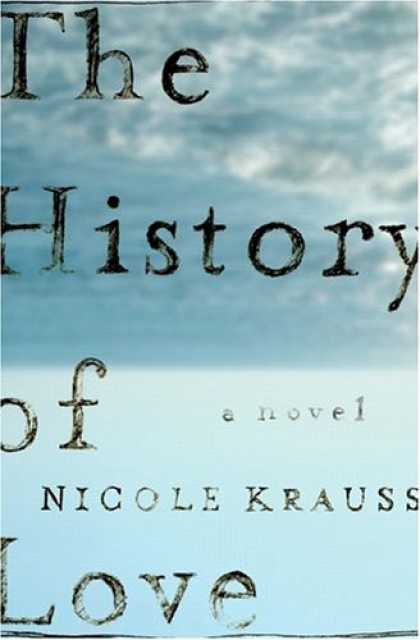

The History of Love, by Nicole Krauss

Disclaimer: This book is confusing. I'm reading it for the second time and I'm still confused. I'll try my best do to a simplified plot summary, but I suggest you skip to the criticism portion of this review, as the book is complicated enough without being condensed. 

The History of Love is told mostly from the perspective of both the young and old selves of Leopold Gursky; Alma, a young girl; and her brother Bird. There's some loose third person narration to fill in the gaps in the history that follows Zvi Litvinoff, Leo's former lover Alma Mereminski (a different Alma), a man named Jacob Marcus, and Bruno, Leo's friend; these aren't main characters, but are necessary to the plot. 

The book entwines many stories. As a young Jewish man in Poland, Leo escapes from his home country as Germany's presence begins being felt throughout Europe. Once in America, he finds his childhood lover, Alma (Mereminski), who'd also fled to America. She has since had Leo's child--Isaac Moritz--presumed her lover dead, and married her boss's son. Leo is heartbroken.

Leo is the eventual author of three books, including one entitled The History of Love (History), which he writes for Alma (Mereminski). At one point in the story, when Leo is very sick, his friend Zvi comes to visit him. While Leo is sleeping, Zvi reads several short pieces of Leo's writing that are sitting on his desk. Zvi steals the manuscript of Leo's book History, and we spend a few paragraphs exploring his guilt over this deception. Later, we discover that a small number of copies of History were published under Zvi's name, unbeknownst to Leo. 

Many years after this, Alma (not Mereminski) comes into the story. Both of her parents loved The History of Love, and the young Alma is named after Leo's lover Alma, who was written into History. Through her brother Bird and her mother's actions, Alma discovers her connection to Leo's lover with the same name, and although her namesake has recently died, the book ends with a meeting between the elderly Leo and the young Alma. (End of summary.)


My main criticism of this book is that it's very complicated. The story is beautiful and very well written, but the multitude of incredibly subtle characters and subplots scream for flow charts and family trees, and--unsurprisingly--distract from enjoyment of the language. The characters are distinct and fascinating, the excerpts of Leo's History included in the book are gorgeous, and both the imagery and the structure are excellently executed. I wouldn't classify the content as inappropriate, but wouldn't recommend the book to most readers under 17, due to the complexity of the story. It requires a great deal of concentration to read, but the exquisite beauty of the story will redeem this book for dedicated readers.


Other things I liked about this book:
  • The slightly dark tone is interrupted with entertaining passages by the younger, strong-voiced Alma. She describes her brother's transformation into an extremely religious young boy, tries to find someone for her mother to remarry, and explores the impact Leo's book History has had on her life.
  • Although its ambiguity frustrates me sometimes, all aspects of the ending are incredibly lovely and fit impeccably with the tone of the rest of the story
  • The jumps between the beginning and the end of Leo's life are fairly well juxtaposed, and it is fascinating to see the character evolve through relationships and travels.
  • Leo's friendship with Bruno, which we see in Poland, during their childhood, and after they're reunited later in life, captures the imagination. It's never revealed whether or not the older Bruno is a real person, but his fascination with Irish audiobook narrators and the motivational techniques that he uses on Leo are very amusing.


If you have any thoughts on the interpretation of The History of Love, or any other literary comments, let me know!

Happy reading--
M. Gabrielle

Friday, April 5, 2013

The Hours


Friday Spines Book Review:


Michael Cunningham’s The Hours is one of my favorite kinds of books: Not only is it composed almost entirely of literary references, the first main character is an authoress, the second is a main character in her book, and the third is a reader of that very book. The authoress is Virginia Woolf, and her Mrs. Dalloway is being read by unhappy 1950’s housewife Laura Brown.


We see Ms. Woolf over a few weeks as she’s making friends with Mrs. Dalloway, entertaining her sister, and having passive-aggressive power issues with her household servant. We meet her steadfast editor husband, Leonard, who tries to help balance the intense terror and pain of his wife’s frequent headaches. Mrs. Dalloway, as some may know, is being reunited with young friends grown old, and dealing with age and death in many different aspects. She is planning a party to honor her friend and ex-lover Richard, who’s receiving an award for his book. (He’s famous for his poetry, and no one has read his book, but since he’s an incredible poet they assume his book must be just as good.) Mrs. Brown is frosting a cake for her husband’s birthday and struggling with the unsatisfying busywork and details of suburban life, centered around family and excluding her own wants completely. She leaves her young son with a neighbor, drives into the city, and rents a hotel room for the day. She spends the afternoon reading Mrs. Dalloway. We see these three characters' lives to near completion, as they encounter catalysts for dramatic changes in their lives and themselves, and the ripples these changes cause in their families and communities.


I’d recommend this book for ages 15 (or more mature early teens) and up; The Hours is definitely not a children’s book, although it reads like one. Cunningham’s light, fluid narrative often contrasts with the darker aspects of the story (of which there are many). The three narratives are distinct and full of personality, and the stories are just separate enough to intertwine continually throughout the story. I suspect I’d get more out of the book if I’d read Mrs. Dalloway, although I’ve heard it can be hard to get through. If anyone has read both books, I’d love to hear your thoughts!


Other things I loved about this book:

  • Hearing about Virginia Woolf’s life and writing process from a first-person perspective was fascinating and quite enjoyable. It’s lovely to read about other writers, especially if they happen to be famous, and especially from such an intimately written narration.
  • Admittedly, I read this book in an afternoon, so it may be that I would have noticed this more had I taken my time with the story. Apart from the obvious connections, as Mrs. Brown reads about Mrs. Dalloway and Ms. Woolf creates her, the overlapping stories and foreshadowings took me completely by surprise. (Always a wonderful feeling.)
  • The ending was perfect--charmingly written and well-fitted with the rest of the book, just enough of a shock to be enjoyable while still being realistic.
  • Although there were darker, not-meant-to-be-subtle aspects to The Hours, the characters' personalities--especially Ms. Woolf’s wry humor--were a well-balanced antidote to those moments.


I just got a book I believe is titled Romancing Virginia Woolf (I don’t have it with me or I’d link to the book) on which I’m hoping to do a short review, tying into this one. If anyone here has read it, let me know! I’m looking forward to the book.

Happy reading!
M. Gabrielle

Friday, March 22, 2013

Le Petit Prince


Friday Spines Book Review:


(Original French text)

 
Firstly let me acknowledge that this is, undeniably, a children's picture book. I'm not sure whether I ever defined an age range for the books here; if there were, it would now be 3-100+. Although marketed towards the very young reader, this book includes fascinating reflections on the meaning of time and growing older, and is worth reading at any age.

The story opens with our artistically challenged narrator, a pilot, stranded on a small island with only his recently crashed airplane for company. He calculates he has enough food and water for about eight days, and after beginning reparations of dubious usefulness, goes to sleep. He’s awakened by a diminutive prince, asking him to draw some sheep. We don't understand why sheep and not, for instance, an elephant inside a boa constrictor; all the tprince will tell our narrator is that he needs a sheep. Our pilot obligingly draws the sheep, and after a few tries, the right kind of sheep--not too old, or too hungry, or too young--is procured.
A curious mix of random and philosophical, juvenile only in its light writing style and young main character, Le Petit Prince conveys both a sense of passing time and motionlessness, exploring different aspects of time as they relate to humanity. Told in a childish manner that is easy to perceive as non-sequitur, the narration is refreshing and by turns bittersweet and comforting. It's a good book to read alone, ponder for a while, and then make your friends read--discussion of the story is basically inevitable.


Other things I like about this book:
  • The illustrations are beautiful, and the background we get on our narrator-pilot's artistic history is charming.
  • Although there are definitely messages to take from the prince's story, the author doesn't try to slip them in or be sneaky in his advice to children. (The advice is rather irrelevant, as you'll read, and quite amusing.)
  • The narrative is primarily told from the pilot's point of view, but the prince's flashbacks are excellently handled. The voice is clearly different, and the transitions are fluent and eloquent.
Author's note: I read this book in French and English; it was an assignment for my French class, and I wanted to do a review instead of an essay. If you know a little French, it's fun to get the book in both languages and read them side-by-side. The author's French is refreshingly different from that of traditional textbooks, and it's fun to see the similarities between the languages.

A second note, also by the author: look forward to reviews of Cloud Atlas, by David Mitchell; 1Q84, by Haruki Murakami; and The Hours, by Michael Cunningham. I'm hoping to do individual reviews as well as a comparison, as they're all told from multiple perspectives.

Happy reading!
M. Gabrielle

Monday, February 11, 2013

How To Breathe Underwater

Friday Spines Book Review:


If you haven't already, please come away from this sentence feeling encouraged to read my Irrelevant Literary Musings on the short story.

Before you start this book:
I recommend that you do not read the stories in order. The opening "Pilgrims" is not bad, but it's more intense than most of the other stories (and somewhat nauseating), and gives an unrealistic representation of the book. I recommend beginning with either "The Isabel Fish" or "Note to Sixth Grade Self"--they're not passive, but will provide an easier transition from life to the intensely captivating world that' is Julie Orringer's writing.

How To Breathe Underwater is a collection of short stories that range in tone from uneasily disturbing to nostalgic and wise. As a whole, the collection of stories could be qualified as a flaunting of Orringer's versatile writing--while Underwater has received criticism that the stories are too similar in subject (adolescent girls being the collection's primary focus) but I'd call it more of a theme. In any case, the expert shifting in narrative tone, voice, and technical style overshadows the parallels between the stories, breaking any trace of monotony.

I'm not going to use the word favorite here, because each of the nine stories has a unique quality to recommend it. The stories I most enjoyed were "The Isabel Fish" and "Note to Sixth Grade Self". In "The Isabel Fish", we build an understanding of Maddy's aversion to water through her science project--breeding fighting fish--and her scuba lessons. Slowly revealed are details of the night her brother's girlfriend drowned. "Note To Sixth Grade Self” is told in the little-used second person as a presumably woman gives universal advice to her unsuspecting Sixth Grade Self. Orringer subtly tells the story through anecdotes such as "do not wear a skirt on the first Thursday of September--it will be windy" and demonstrates an excellent grasp of second person writing through the ease in which the story is told.

Some of the stories--e.g., "Stars of Motown Shining Bright"--have premises that seem totally unrealistic to me. Our narrator Lucy is around sixteen, and is in a semi-subtle competition with her friend Melissa over a boy's attention. Lucy has just slept with said boy (Jack) but is once again overshadowed by Melissa, who traps Lucy into being an accomplice in her plan to elope with Jack and become a model. The two come frighteningly close to accomplishing their goal--they acquire a car and drive to Detroit, with "borrowed" money and a gun that only Lucy knows about. Finally Lucy gets fed up with Jack, who's still flirting with both her and Melissa, and demands that they return home. If this were a novel, I'd probably enjoy the story but be dissatisfied with the unlikeliness after finishing it. However, told in Orringer's matter-of-fact style and kept brief, it's easier (but not completely effortless) to focus on discussion the characters and plot instead of arguing with the book about implausibility.


Other things I liked about this book:
  • The variety of narration, which is so adept I must reiterate it. Simultaneously refreshing and unsettling, the stories are juxtaposed in tone, characters, and setting, but still manage to retain a subtly sense of unity.
  • The titles are beautiful, and provide another thought-provoking piece of the succinct short stories to analyze.
  • This isn't a note on any specific story, but I appreciated Orringer's variety of perspective on children and young people's experiences. She ranges from clever retellings of middle school angst to parents with cancer to the death of friends. It's wonderful to see a collection of such accuracy and variety among the barrage of badly-written vampire romances, and allows me, as a teenager, to see my persona able to reclaim a sense of dignity in the literary sphere. 

Although I've never made it through a book of short stories (that I remember), I'm also reading a book of Colette short stories that's absolutely excellent. (Here's the Amazon link. If you can get the forward by Erica Jong I recommend it!)


Happy reading!
M. Gabrielle

Thursday, January 31, 2013

Irrelevant Literary Musings

In which I prove that the only worthwhile short stories are badly written


Let me emphasize my aversion to short stories: There are three possible outcomes of reading a short story. If the story is good--if it uses narrative to convey feeling, story, and tension; manages to foreshadow impending doom with a single innocuous sentence; if it skips the climax and ends with a quiet dénouement or "concludes" directly after all the characters have suddenly dropped dead--you will not be able to rest. Your stomach will continue along the trajectory of the main character's path from cliff to rocky ocean, and the story's abrupt cease will only deepen the nausea felt as you wait for the character to black out just before impact. Even if the character has time to recover from the emotional simultaneous loss of their mother, sister, and husband before the story ends, you do not recover: For your character two years may have elapsed, but a single page is not enough time for a reader to grieve. 

If the story is mediocre, it will have a minimal impact on your life--you won't remember it well enough to be reminded of your main character even when you bake her favorite cookies. It will be as if the story never existed.

If the story is bad, however, you're left with a slight dissatisfied feeling in your stomach: no emotional damage will have been caused; you won't have inherited the main character's devastating (but ineptly written) fear of shoes; and moreover, you'll have the satisfaction of knowing you only wasted twenty minutes reading this flop of a story. This far outweighs any possible effect even the best short story could have--for no short stories end happily. Those are known as children's books. 

Thus ends my discourse on the evils of the "good" short story: Please await my review of How To Breathe Underwater, by Julie Orringer (a collection of her short stories) with bated breath.

Happy reading!
M. Gabrielle

Friday, January 18, 2013

Bel Canto

Friday Spines Book Review:


I was slightly apprehensive when my English teacher summarized this book ("It's about a South American hostage crisis") and wasn't reassured by her insistence that it wasn't heavy or political. After reading Bel Canto I can only say that it's about a South American hostage crisis and isn't dark or political at all.

The story opens with a birthday party for a Mr. Hosokawa--a wealthy Japanese businessman, visiting the country for a few days only. The poor government of the South American country, hoping for a factory deal to boost their tiny economy, lured him with the promise of Roxane Coss's voice. Through flashbacks, we see his obsession with the singer as it evolves from watching her opera performance as a child to listening to records of her singing for hours every night. He couldn't refuse the chance to hear her sing at an intimate dinner party, just for him. And then the lights go out, terrorist pour through the house via heating ducts, and all 200 people at the party are suddenly held hostage in the Vice President's impeccable house. 

It must be understood that there are two groups of terrorists: La Direccion Autentica, and La Familia de Martin Suarez. The first is notoriously cruel and brutal, well-organized and ruthless. And the the second, it becomes clear, is a group of shy teenagers with guns. Led by three older "generals", the footsoldiers have barely enough training to cover up their youthful habits and instincts; their guard is easily dropped, and they're more curious than hostile towards their new hostages. 

The government quickly surrounds the Vice President's property with bullhorns and police cars, constantly shouting out demands that barely permeate the thick fog both literally and figuratively enveloping the house. Garua, a thick fog that hangs in the air from April to November, kept the house isolated from the outside world. There's a messenger that comes regularly from the government, bringing boxes of food and supplies that the terrorists demand--demands met in return for the continued life of the important international officials they hold captive. As time goes by, they agree to release the women and the sick--200 hostages are simply too many for the band of 20 terrorists. They'd expected to storm the party, capture the president, collect their ransom and be done, but the president had wanted to watch his favorite soap opera, so instead they took the Vice President, the 50 hostages most valued by their countries, and Roxane--the soprano. 

Life for the remaining hostages settles into a surprisingly gentle routine: No meetings to attend, no jobs or wives and children to worry about, no responsibilities at all. They're not even afraid of the terrorists, no older than their own children, as the two groups fall into the easy rhythm of nothingness. Surprising new talents are unearthed, different interests explored, and many of the hostages form close friendships--and more--with both each other and their captors. 

There is, of course, an ending to both the story and the book: November passes and the fog lifts, and the hostages are slowly allowed outside. Some run laps around the house and some start work on the giant weeds choking the garden, but they have no thought of escape from this surprisingly beautiful, cloistered life. (Please, don't read the next part unless you've finished the book! Enjoy the foreshadowing and keep yourself in the dark.) One day during the hostage's outside time, the government agents that are still stationed around the house storm the walls and begin shooting. Lovers die in each other's embrace, close friends are once again forced apart into roles of terrorist and newly-freed hostage, and the close-knit life, filigreed with pure happiness, is ruined in a few minutes. (No more spoilers!)

The way the narration is woven with a fascination for Roxane, the opera singer, reminds me of Eva Ibbitson's YA writing style. (An excellent example is A Countess Below Stairs, which I just reviewed.) It's not that all the characters are hopelessly in love with her, although that's true in many cases, but they're all attracted to her and her voice on some level. It provides her character with an irritable luminosity that comes so naturally to the writing that it's hard to notice, as we're under her spell along with those around her.

I recommend this book for ages 16 and up. More advanced readers will have an easier time with both the subject material and the language/writing style, and it's definitely a book that you should  enjoy instead of forcing yourself though. There is violence (not at the places you would expect, but I won't give anything away), but it's not overwhelmingly descriptive. Several of the characters fall in love and sneak off to abandoned bedrooms for a few nights, but this isn't graphic or crude either--it fits with the sustained luminosity of the writing, the beauty of simple human lives that transcends even this environment and situation. 

Other interesting things about this book:
  • The perspective is third-person omniscient, but it shifts to follow a small range of different characters. It's mostly told from the perspective of the captors, but occasionally we hear from one of the terrorists, or even someone outside the walls.
  • The theme of music throughout the story made sense, but I'm not quite sure I liked it--as a classical pianist I understand the universality of the "language of music" and I loved how Roxane and her accompaniest could communicate without speaking the same language, but it felt too sporadic. Her singing would have monumental importance and be able to transform the whole mood of the characters and story, and then for the next part of the story would not be mentioned. I would have appreciated more consistency.
  • The ending--it's terrible and beautiful, and while certainly not what the reader hopes for, is inevitable. While the epilogue wasn't completely necessary, it guides the ambiguity of the ending nicely, and leaves the reader with a little bit of peace.
  • Throughout the book, the voice is fairly consistent, but the tone of the writing changes with the events of the story: Upset and rattled at the beginning, when the guests are first taken hostage, it fades to sleepily complacent and even content as the hostages themselves settle into their new lifestyle. 


Don't forget to like Friday Spines on Facebook for more updates, book recommendations, and literary antidotes to the horrible spelling on the Internet!

Happy reading--
M. Gabrielle

Friday, January 11, 2013

The Last Time I Saw Paris


Friday Spines Book Review:


Warning: This is not a romance novel! Nor is it a one-sided account of a woman turned traitor to her husband/lover/country, swept off her delicate, high-heeled ankles by a dark stranger and into the intelligence network of the rebels. 

Powerful New York socialite Claire Harris Stone must flee her glamorous life when a connection to her past (formerly Clara May Wagner, Claire raised herself and her siblings on an Oklahoma farm) threatens the new life she's built on lies. She travels to Paris to be with her lover, the artist Laurent, unaware that Nazi invasion has begun while she travels. After a quarrel with Laurent, she manages to find a job as a florist at a prestigious establishment. 

(I recommend you stop reading here, as the plot is wonderfully enthralling!) 

She is reluctantly involved in the French Resistance; bribed with false identity papers that she needs to remain in Paris, Claire finds herself further drawn in, but refuses to become sympathetic to the cause for its own sake. A friend of Laurent's, intriguing, infuriating Englishman Thomas Grey crosses paths with Claire a number of times in her work for the Resistance, and the two become tenuous friends, if intense acquaintances. 

The two are forced to flee the city when the security of the Resistance is compromised by an unknown spy; they take refuge in the countryside together, along with two young girls and a wounded pilot. The five wandering, transplanted people form a sort of a family; Grey and Claire fall in love (almost predictable, but the negative intensity of their relationship through the early part of the story make it a more thrilling romantic subplot), only to be torn apart when Grey must return the pilot to England. 

A few months later, Grey is believed dead; Claire is working for the safety of the two girls and her friends in the city. Using her looks and personality to gain information from the Nazis back in Paris, she continues to aid the Resistance for her friends' sake, but is eventually captured. Seconds before her execution, there's an organized revolt against the prison where she's being held, and she escapes with her life. Nearly six months pass before Grey appears back in the flower shop where Claire is once again working--he travelled miles from the forest where he was shot (but not killed), and there's a bittersweet happy ever after.

(It's safe--spoiler free from here down!)

The author seamlessly blends French, British and American English along with a subtly evocative narration style to envelope the reader in scenes of Paris and the French countryside. The dialogue is realistic and excellently portrays the characters without stating the obvious: It's clear that Madame Badeau, Claire's friend and mentor at the flower shop, is Parisian in the best way, yet we learn this through her words, the way she arranges flowers, how she treats Claire, rather than it being flatly laid out for us. Sheene's plot quietly brings us along with the different characters, touching on different points in Claire's life without being confusing. Her journey through the years in France is riveting, though not uncomfortably so. The reader may feel homesick for Paris after reading this book (see bottom of post).

I recommend this book for ages 15 and up (not YA fiction, but can be read by more mature young readers). While it's not irreverent writing, there are fairly graphic (although not over-the-top) scenes involving shooting, as well as drinking, and sexual favors and violence. Claire's first marriage (in New York) is abusive, with both her and her husband clearly only using the other for their personal gain. However, there's genuine and respectful love in many different kinds of relationships: her dear friend Madame Badeau at the flower shop is a strong and ethical character; Claire has recurring friends throughout the book that she relies on for kindnesses, and she tries her best to repay them; her relationship with Grey evolves to be passionate, kind, and loving--while he's not a Prince Charming, he's quite easy to fall in love with. 

Other things I liked about this book:
  • The contrast of the settings (high society in New York, both the poorest and richest parts of occupied Paris, rural French countryside) are deftly portrayed with equal interest and attention to detail.
  • The theme of the garden picture: Laurent is a photographer, and at the beginning of the story Claire falls in love with a photograph of Paris that leads her through the story.
  • The characters are vivid and believable: Not all are one-sidedly good or bad, but the author doesn't allow each character to mature and develop excessively over the story.
  • Excellent balance between dialogue and narration keeps the story readable but easy-to-follow.

More Paris:

Happy reading!

M. Gabrielle